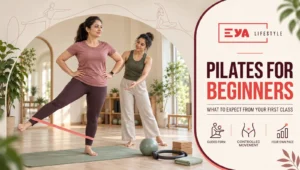
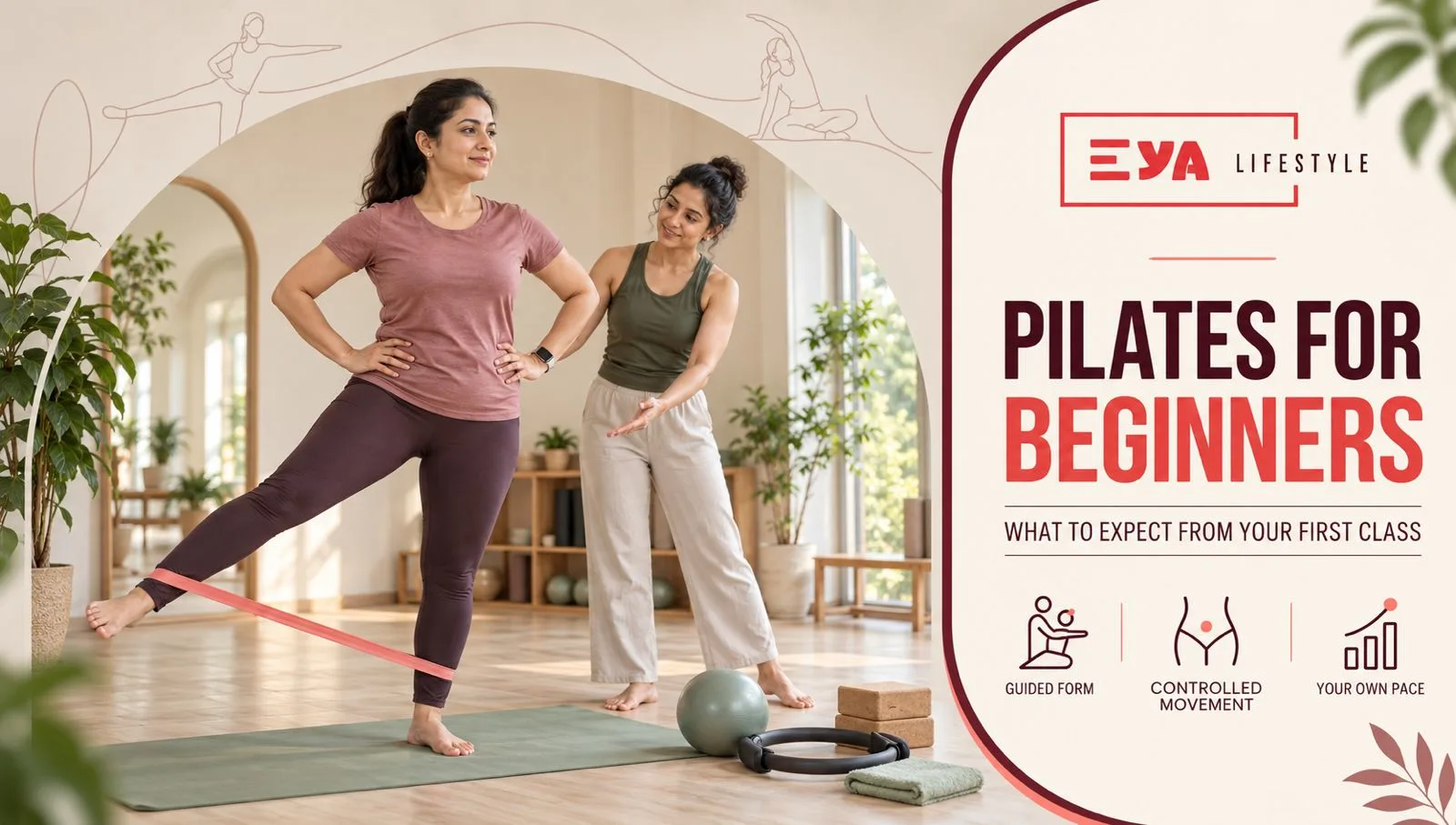
New to Pilates? Here is a little story. You don’t need to be flexible. You don’t need a strong core. Even if you’re not familiar with the names of any of the exercises, it’s OK. Pilates for beginners is only the beginning: you are learning to breathe, engage the right muscles, control your movements, and gradually build strength.
Your first few classes will look much simpler than those fancy videos you see online. That is completely normal.
A great Pilates session always starts with understanding your body. So if you are wondering what to expect from Pilates, expect fewer rushed movements and more focus on how each exercise actually feels.
What Is Pilates for Beginners?
Pilates is a gentle form of exercise. It is about controlled movements, core strength, posture, breathing, and stability and mobility.
Pilates for beginners teaches these skills through simple movements that are easy to understand and control. You add more resistance or a larger range only later. Being new does not require a special kind of Pilates. All you need is the right beginning and a straight path to success.
At EYA Lifestyle, our Pilates Centre in Noida follows the same thinking. If not, you don’t need to do the full range of motion if it doesn’t feel right for your body. We identify what is missing, whether it’s mobility, stability, strength, coordination, or control, and we develop it gradually.
What Happens in Your First Pilates Class?
The first time you walk into a class at Pilates, it can be a bit weird. The teacher begins to discuss neutral spine, core engagement, alignment, and controlled breathing. It can sound confusing at first.
But don’t worry. Nobody expects you to know these words already. A good class introduces everything slowly and clearly.
Understanding Your Starting Point
The instructor will first observe you move before making things harder. They will observe whether you are sitting squarely, balancing and moving around, and if you can control basic movements.
Please tell them about any injuries, pain, pregnancy, recent surgery, or health issues before starting. This will help you determine where small adjustments are needed.
Learning Breathing and Core Engagement
Beginners often notice Pilates’ focus on breathing and control first.
You are not doing many repetitions; instead, you are practicing breathing in sync with the movement. You also develop greater awareness of your abdominal and trunk muscles.
Core engagement does not mean sucking your stomach in hard. It means learning how your trunk supports and controls the movement.
Moving Slowly On Purpose
Your first Pilates class may have movements that look very easy. Then you try them. Pilates employs slow and controlled repetitions. With good alignment and muscle engagement, even small movements can be difficult. Slow does not mean easy. In Pilates, slow usually means you are finally feeling the real work.
What Does a Beginner Pilates Workout Include?
A beginner Pilates workout is meant to build strong foundations. It should not surprise you with higher-level exercises in your first class.
This will vary depending on the teacher, the format, and what you can do already. Most beginner sessions focus on a few areas.
Core Control and Stability
Pilates is known for core work. But beginners first need to learn how to activate and control the trunk properly. Exercises slowly challenge the abdominal muscles, lower back, hips and pelvis together as one support system.
Mobility and Flexibility
Not every tight area needs hard stretching. Controlled spinal movement, hip mobility, shoulder movement, and gentle range-of-motion work help you understand where you move freely and where you need gradual improvement.
Lower and Upper-Body Strength
Pilates for beginners isn’t just about the stomach. It also targets glutes, lower legs, upper legs, arms, shoulders, and back muscles without losing focus on alignment and control.
Balance and Coordination
As you improve, Pilates starts asking different body parts to work together while you stay stable. This improves coordination and body awareness along with strength.
Mat Pilates or Equipment Pilates: Where Should Beginners Start?
Both options are useful.
Mat Pilates sessions mainly use your body weight and the floor. Sometimes small accessories are added. Equipment-based Pilates can give resistance and support through special apparatus.
Neither is automatically better for beginners.
A well-planned Mat Pilates class can teach control, breathing, alignment, and body awareness without needing complicated equipment.
If you are looking for the best Mat Pilates studio in Noida, don’t just look at the interiors. Check the instructor guidance, class size, how movements progress, whether modifications are available, and whether the studio actually teaches you to understand the movement. These things matter much more after the first class.
What Will Pilates Feel Like as a Beginner?
This is another important part of what to expect from Pilates. Many beginners underestimate it. You may not finish the class completely sweaty. But muscles you rarely notice can suddenly start working. A workout does not have to leave you very sore to be useful.
You May Discover Muscles You Weren’t Using Well
Controlled exercises often make you notice smaller stabilising muscles. You also start seeing where your body usually takes shortcuts.
Coordination May Feel Awkward Initially
At first, it can be difficult to coordinate breathing, maintaining alignment, and moving another part of the body. With practice, it becomes more natural.
Progress May Look Different From Traditional Fitness
Progressions are not just about the weight or the reps. For beginners, progress in Pilates can mean controlling a movement more effectively, holding a position longer, extending your range of motion, feeling more stable, or finishing an exercise that was previously challenging.
What Are the Benefits of Pilates for Beginners?
Regular practice at the right level can help improve all of the following.
Better Core Strength
Pilates trains the trunk to support movement. It does not treat the core as something you only work through crunches.
Improved Posture and Body Awareness
When you practice often, you’re more conscious of how you are sitting, standing, staying stable and moving throughout the day.
Greater Mobility and Flexibility
Controlled movement through comfortable ranges can slowly improve mobility without making flexibility the only goal.
Improved Balance and Stability
Pilates challenges the body to stay in control as movements become more demanding.
Functional Strength
The aim is not to fatigue a muscle. With improved control, stability, mobility, and strength, your body moves and functions more easily during your daily life and other physical activities.
How Often Should Beginners Do Pilates?
The number of sessions varies from person to person, and there is no set number. Practice frequency will vary based on fitness, recovery, goals, other exercise, and how difficult the practices are.
When you’re a total beginner, it’s better to be consistent than to try too much, too soon.
An introductory Pilates exercise should allow the body to learn and acclimate. Once movement quality improves, you can increase the exercises and frequency at an appropriate rate.
How to Choose the Right Pilates Studio in Noida
Don’t just book the nearest class at a Pilates studio in Noida.
Look for Pilates experts in Noida like Ena Gupta and team who focus on improving movement quality rather than having everyone perform the same routine.
Consider these points:
- Instructor guidance and experience
- Beginner-friendly progressions
- Attention to form and alignment
- Suitable class sizes
- Exercise modifications when needed
- Combination of mobility and strength
- Your individual goals and limitations
The best Pilates Centre in Noida should guide you properly without making you dependent on the instructor for every movement. This becomes especially useful when Pilates is part of a wider movement and wellness routine.
Start Pilates at EYA Lifestyle
Starting Pilates should not feel like an audition for an advanced class. At EYA Lifestyle, beginner Pilates starts with what your body can do today. Our movement specialists start with the foundations. Then they slowly build mobility, stability, strength, coordination, and movement control.
As a Movement and Wellness Centre in Noida, EYA Lifestyle does not treat Pilates as a separate workout. Our classes combine Pilates, yoga, strength training, calisthenics, rehabilitation, and other movement methods based on the individual’s needs.
If you’re taking Mat Pilates lessons, preparing to start exercising after a while, or just want to understand how your body works, the first step isn’t to do everything correctly.
First, learn the movement. Then make it your own. Contact us today to get started with your first Pilates movement.
FAQs
1. Is Pilates suitable for complete beginners?
Yes. Low-level breathing, alignment, mobility and stability, and controlled exercises are good starting points for Pilates for beginners. Later, we introduce more complex movements.
2. Do I need to be flexible before starting Pilates?
No, flexibility is not a prerequisite for joining. Proper guided practice will help you develop mobility and flexibility gradually.
3. What should I wear to my first Pilates class?
Please come dressed in comfortable clothing that lets you move freely and lets the teacher see your alignment. If needed, the studio will explain what to wear and which type of socks to wear.
4. Is Mat Pilates good for beginners?
Yes. Mat Pilates is a good way for beginners to learn core engagement, breathing, alignment, stability, and body control using mainly body weight.
5. Is Pilates only for core strength?
While core control is a key focus in Pilates, the exercises also build the legs, glutes, back, shoulders, arms, mobility, balance, and overall coordination.