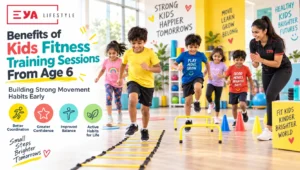
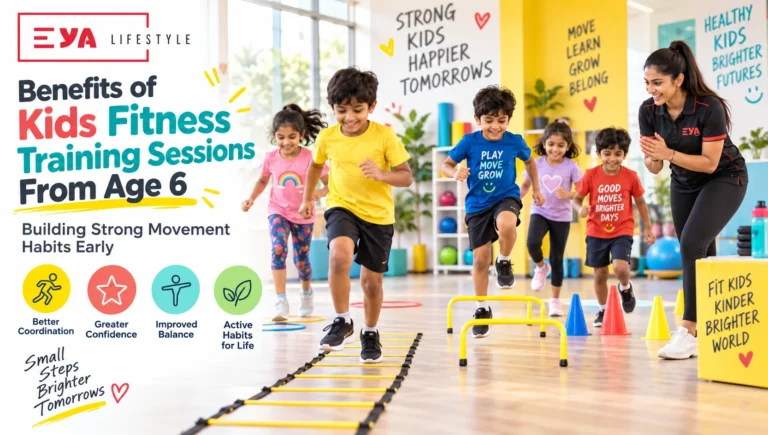
Kids fitness training sessions help 6-year-olds move, play, and build healthy habits. At this age, physical activity should feel fun, playful, and enjoyable, creating positive associations with movement that encourage kids to stay active as they grow.
Many children spend long periods sitting at school, at home, and while doing their homework. Starting structured kids’ fitness activities at age 6 gives them time to learn to run, balance, coordinate, stretch, and strengthen in age-appropriate ways.
At EYA Lifestyle, Kids Training in Noida helps children build strong movement habits early without adult-style workout pressure.
About Kids Fitness Training Sessions
Kids Fitness Training Sessions match a child’s age, current skill level, and developmental stage. They skip heavy weights and performance numbers. Instead, they focus on coordination, mobility, balance, bodyweight strength, stamina, and varied movement patterns.
Children participate in a range of activities at a Movement and Wellness Centre in Noida and are guided to understand how their bodies work. The primary goal is to make physical activity normal, fun, and something children can keep as they grow older.
Types of Kids Fitness Training Sessions
Not every child enjoys movement the same way. Some prefer high-energy play while others connect better with balance, body control, or strength challenges. A solid kids exercise program therefore mixes different movement types instead of repeating one fixed routine.
Functional Movement Training
Functional movement is how children move in daily life, such as squatting, crawling, reaching, running, hopping, and changing direction. Age-appropriate functional training in Noida builds better coordination and body control. It also gives children a practical base for daily activity and recreational sports.
Yoga and Mobility Training
Not all sessions need to be fast. With guided yoga classes in Noida, children practice flexibility, balance, mobility, and body awareness. Slow, controlled moves help them learn to slow down, sense where they are in space, and move more fluently across a wider range.
Zumba and Rhythm-Based Fitness
For those kids who enjoy active movement, Zumba classes in Noida can transform exercise into a fun activity. When music is matched with other rhythms, it stimulates stamina, coordination, and movement of the whole body without making fitness sound like the same old drill.
Calisthenics and Bodyweight Training
Children can begin building strength using their own body weight instead of external loads. Crawling, supported holds, balance tasks, and controlled bodyweight movements may be incorporated in age-appropriate calisthenics classes in Noida. These gradually build strength, stability, and confidence in movement.
Benefits of Enrolling in Kids Fitness Training Sessions From Age 6
Early movement isn’t about producing athletes at age six. It is about handing children physical skills they can keep using as they grow. Kids Fitness Training Sessions support everyday confidence, school activities, and participation in sports.
1. Builds Coordination Early
Children keep learning how different body parts work together. Running, hopping, changing direction, and moving arms and legs at the same time develop kids’ strength and coordination. This makes harder skills easier to pick up later.
2. Develops Balance and Body Awareness
Balance lets children manage their bodies during play, sport, and daily life. Moves that change position, height, and direction improve kids mobility and balance. They also help children know where their body sits in space.
3. Introduces Strength Naturally
Strength doesn’t have to start with dumbbells. Crawling, climbing, controlled squats, holds and other bodyweight moves challenge muscles in a natural way. Good movement training for children puts control and technique first before any extra resistance.
4. Supports an Active Lifestyle
Structured movement becomes a regular part of a child’s life, making it more normal to remain active rather than forced. Kids fitness training sessions foster an active lifestyle for children, extending to play outdoors, recreational activities, and their daily movement.
5. Builds Stamina
Children need stamina for more than sport. School games, playground time, walking, running and climbing all call for endurance. Regular fitness activities help children stay active longer without turning every session into an all-out effort.
6. Improves Movement Confidence
Not every child feels at ease with physical activity right away. Guided challenges let them learn at their own speed and notice small gains. When more one-to-one attention helps, personal training in Noida can shape movement progress to match a child’s ability.
7. Makes Fitness Enjoyable
Children stick with activity more readily when movement stays engaging. Games, challenges, partner work, and mixed sessions keep kids’ fitness training sessions interesting while still building real skills such as balance, coordination, and strength.
8. Builds Healthy Family Habits
Kids tend to adopt at-home behaviors that seem normal to them. Families that make movement and active time normal can help children see wellness as a way of life. Family wellness workshops in Noida give families a chance to exercise together, not separately.
Can Kids Fitness Training Sessions Help in Sports Injury Rehabilitation for Kids?
Kids Fitness Training Sessions are sometimes part of the return-to-activity pathway after a sports injury, but only after the child gets medical clearance and is ready for structured movement.
Sports injuries may temporarily reduce mobility, strength, balance, confidence, or coordination. Delaying until the pain eases and then returning to full sport can place the child in demands that are beyond his/her capacity.
A structured Rehabilitation Centre in Noida or a qualified healthcare professional first checks the injury. As recovery moves forward, sports injury rehabilitation in Noida can gradually restore the physical abilities needed for activity.
Depending on the injury and professional advice, this may cover:
- Restoring comfortable mobility and range of motion
- Rebuilding strength around the affected area
- Improving balance and joint stability
- Recovering movement control and coordination
- Gradually reintroducing running or jumping
- Practicing changes of direction when appropriate
- Preparing for sport-specific movements
- Monitoring how the child responds as activity increases
Conclusion
Starting kids’ fitness training sessions from age six gives children more than just an activity slot. It brings balance, mobility, strength, stamina, coordination, and confidence to their life before it is fully developed, before they are connected with movement.
EYA Lifestyle is the best movement and wellness centre in Noida that integrates the concept of kids fitness, yoga, Zumba, calisthenics, rehabilitation, and family wellness. Children can try movement in different ways as they grow.
Explore Kids Training in Noida at EYA Lifestyle and help your child build healthy movement habits that grow with them, rather than habits they have to fight to build later.
FAQs
1. Is age six too early for fitness training?
No, as long as the training fits the child’s age. Sessions should centre on coordination, mobility, balance, bodyweight strength, and enjoyable movement instead of copying adult gym routines.
2. Does a child need to play sports to join kids fitness sessions?
No. Children can join simply to stay active, improve movement skills, and build physical confidence even if they don’t take part in organized sport.
3. Can kids training include strength exercises?
Yes, but the strength work must match the child’s age and ability. Strength can be introduced via bodyweight exercises, balance challenges, and controlled exercises, without any extra load.
4. How can fitness sessions help children who spend a lot of time on screens?
Fixed activity time gives children a clear slot to move, interact, and use their bodies. It can support a healthier balance between screen time and physical activity.
5. What should parents look for in a kids fitness program?
Ensure appropriate supervision, age-appropriate development, a range of activities, consideration for individual abilities, and a child-friendly environment that promotes learning and enjoyment of movement rather than constant competition.